How Nicholas Gibson-Dees Found His Future in Metrology at Machine Specialties, Inc.
Published: March 2, 2026
Apprentice Background Information
-
Name: Nicholas Gibson-Dees
-
Company/Employer: Machine Specialties, Inc.
-
Age: 19
-
Apprenticeship Occupation: Metrologist
Can you tell us a little about yourself and what first sparked your interest in your current career path?
I have always been interested in understanding how things work. This is likely because many of my family members have been/are mechanics, engineers, machinists, and the like. I grew up learning that anything can be broken down into its base components, and reconstructed, which is exactly what I did anytime I was given the chance. This led to me wanting to be a mechanical engineer and specifically wanting to work on developing or improving aircraft. Towards the end of the 12th grade, my class was visiting the local community college, and we were told about the Registered Apprenticeship Program. What really caught my attention was that the program seemed to be directed towards people like me, who are mechanically inclined.
Before becoming an apprentice, where were you in your career journey? What were you looking for that you weren’t finding through more traditional education or job pathways?
I had begun taking classes at Alamance Community College that could be transferred to a four-year school, and that were required for an associate’s in engineering. Aside from that, the closest I was able to come to furthering my journey with the resources I had at the time was a week-long shadowing of a structural engineer. My next steps would have been to fully commit to an associate’s in engineering, and apply to N.C. State University, in an attempt to pursue the required education.
How did MSI and its Registered Apprenticeship Program first get on your radar? What stood out to you at the time?
MSI, and the Registered Apprenticeship Program as a whole, first piqued my attention when my class was visiting the community college. We went on a tour of the campus, which eventually led us to the building where specialized trade classes are held. The Machining instructor at the time, Dan Quatrone, had talked a little bit with my class about the [Registered] Apprenticeship, and I immediately began looking into it. A part of the process of becoming an apprentice requires you to go to one or more of the companies that are a part of the program to take a tour. There was only one more scheduled tour available at the time, which I managed to jump into. There, I realized that the apprenticeship would be my greatest opportunity to get the kind of hands-on career that I wanted, as well as the valuable experience that so many companies today look for.
What ultimately made you decide that a Registered Apprenticeship was the right fit? Was there a moment when it “clicked” that this was the path you wanted to take?
Another part in the process of becoming an apprentice is to attend an orientation, where the participating companies impart information about who they are, what they would expect of the apprentices, and why the Registered Apprenticeship is important to them. When MSI was up to discuss their company, one of their graduated apprentices stood up, and spoke about his experience. What really set my choice in stone was that he, too, wanted at first to be a mechanical engineer, but after going through the apprenticeship, he realized that metrology was the field he wanted to be in. When I was accepted into the next stage of the program, a two-month period where future apprentices test the waters, I was placed under the same man who spoke about wanting to be in metrology. I talked with him about his career path and realized that he and I were almost 1:1 in our interests, and what caused us to join the [Registered] Apprenticeship.
You’re currently a Metrologist Registered Apprentice—a career many people aren’t familiar with. How would you describe metrology in your own words, and how did you discover this field?
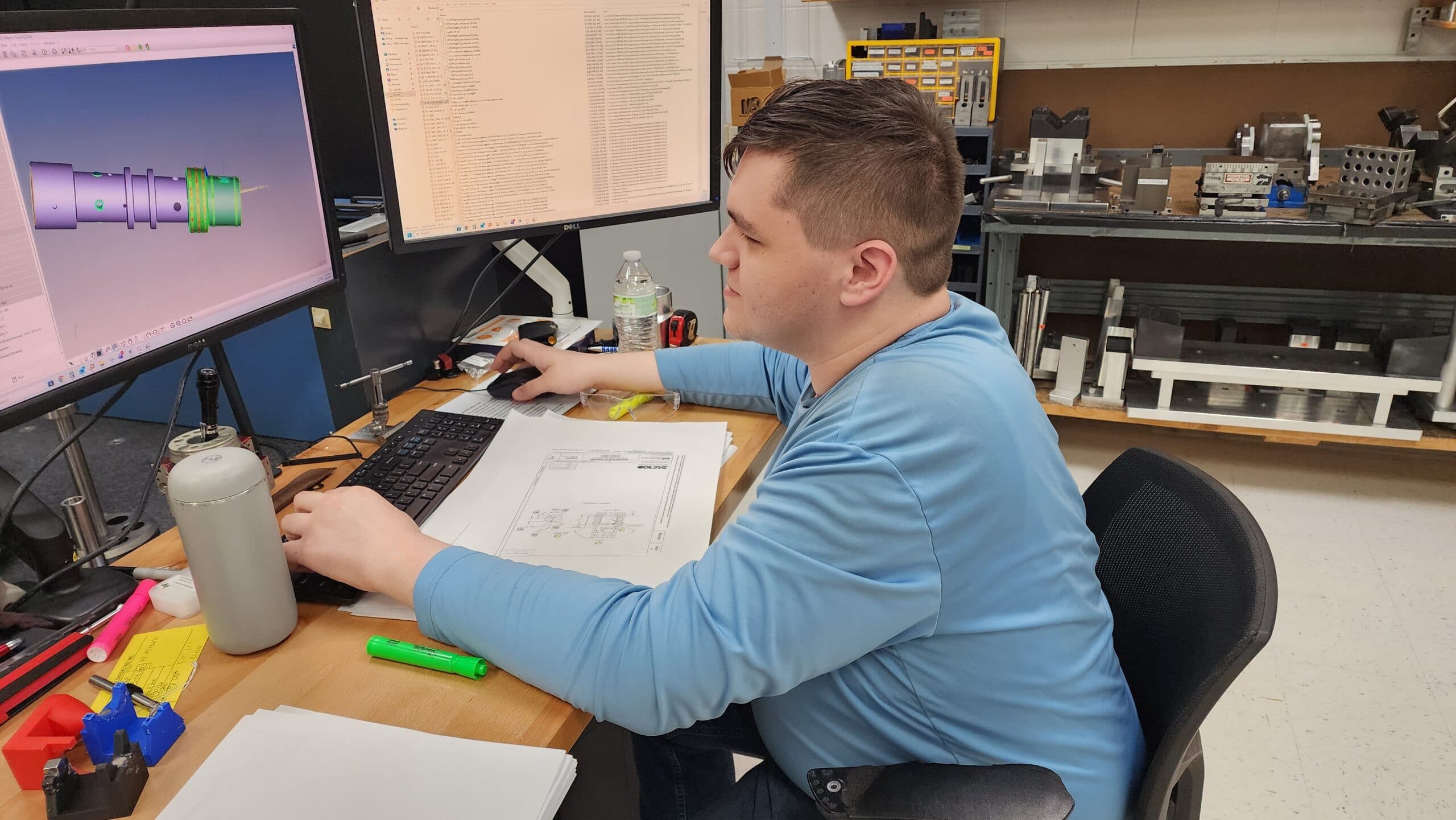
Metrology is defined as the scientific study of measurement, but that almost feels to me like calling an avocado a fruit. Yes, that is the legally correct term, but in terms of manufacturing, it is better described as the gathering of complex data required to prove that your product conforms to the customer’s designs. I discovered this field when I was placed under the aforementioned graduated apprentice in week one. I then was moved to another mentor whose job was still in the field of metrology, but vastly different. The first mentor was tasked with ensuring that all of our measuring equipment was calibrated frequently, while the second mentor was tasked with programming and operating Coordinate Measuring Machines (CMMs). That is the specialized field of metrology I am working towards mastering. Our job is to use precision probes to scan features of parts, and pull complex, and sometimes otherwise impossible to collect data off of the part to ensure our products meet their listed requirements.
What does a typical day look like for you as an apprentice? How do your responsibilities connect to the work of the larger team or organization?
As a third-year apprentice, my job in my team is to ensure all of the parts delivered to us are set up exactly how they are meant to be while being probed to ensure the machine does not crash, as well as programming the CMMs, interpreting data, understanding and communicating what needs to happen when data comes back, showing that the part does not meet its requirements, and deciphering the best method to backcheck the machine, to ensure the data is real when requirements are not met.
What skills or knowledge have you gained through the Registered Apprenticeship that you’re most proud of so far?
The most crucial skill that I have developed since starting the apprenticeship is not something you would expect, like programming, or critical thinking, but rather, communication. Growing up, I struggled to communicate my thoughts, emotions, needs, and intentions. By becoming a part of our quality control team, I had to learn how to communicate to the machinists, as well as my fellow coworkers. Now, I am able to properly communicate with others, both in regard to work, and life as a whole. To put it plainly, without the Registered Apprenticeship, I would have only had one sentence answers for each question posed to me in this interview, without ever being able to convey what I really meant.
How has the combination of on-the-job training and related classroom instruction supported your growth? Why do you think this model works?
I believe that the classroom instruction has helped me to develop a better understanding of how the machines work that actually cut the parts we produce. A lot of my schooling has been geared towards Computer Numerical Control machines, due to the fact that CMMs themselves are generally too specific of a field for a school to have more than one section of a class dedicated to them. That being said, the on-the-job training is more than sufficient for me to learn how CMMs work, but without the schooling, I would be unable to properly discuss what machinists may or may not need to change in their codes in order to fix their parts.
How has participating in a Registered Apprenticeship changed your confidence, career outlook, or long-term goals?
By participating in the Registered Apprenticeship Program, as long as I continue to show a desire to grow, learn, and improve, I will eventually graduate with multiple years of experience, as well as an Associate’s degree, and a Journeyman’s license. This means that, while I do not plan to leave my company, if I am ever in need of a new one, I will have three pieces of the puzzle that employers are constantly looking for from people in my field. This helps me to feel confident that I will always be able to provide for myself and my family, which indirectly helped me to make the decision to propose to my fiancée.
From your perspective, how does having an apprentice benefit an employer or organization? What value do you feel you bring to the workplace?
The most straightforward answer I can give is that, by becoming an apprentice, you are presenting your company with someone with little to no experience or knowledge, while that seems like a negative trait, this means they are able to teach you how they need you to be taught. There is not going to be any butting heads about how your previous company did it, or about how you have always done something, because you have never done anything like what you will be doing when you are an apprentice.
For career seekers who may be unsure about their next step, what would you want them to know about Registered Apprenticeship?
Patience is key. When you are an apprentice, you will have to do things that you do not want to do. You will not be paid what you think you are worth, and sometimes it will be tempting to say, “I do not get paid enough to care,” but that is exactly where most people mess up. Yes, the pay may not be the greatest when you are an apprentice, but when you graduate, your efforts and your willingness to stick with it will be reflected in your pay, and in your job title. When I started, I was given a crowbar, a sledgehammer, and some gloves on numerous occasions, and went outside to break down large crates to be recycled. It wasn’t fulfilling work, and it wasn’t exactly fun when it was seventy-five degrees out, but because I chose to not quit what I started, I have made progress towards living a comfortable life much faster than if I chased easy jobs or the money.
And for employers considering Registered Apprenticeship as part of their workforce strategy, what would you say to encourage them to explore it?
I believe that Registered Apprenticeships are a key to success in any industry. Most fields that are overlooked are overlooked because no one talks about them and no one reaches out to the new generation. MSI apprentices or graduated apprentices alone make up nearly 50% of our quality control lab team alone, not to mention the numerous IT techs, machinists, and secondary process team members who all have been a part of this program. I believe that [Registered] Apprenticeship will be what allows companies to not only survive, but thrive for generations, as long as time is spent making sure that they are utilized properly.
ApprenticeshipNC in Focus showcases the people and programs advancing Registered Apprenticeship across North Carolina. By spotlighting Registered Apprentices and Registered Apprenticeship Programs, this series showcases high-demand career pathways, innovative training models, and the partnerships strengthening our state’s Registered Apprenticeship ecosystem. Released by ApprenticeshipNC, each feature reflects the impact and value of Registered Apprenticeship in action.
About ApprenticeshipNC: Recognized by the Office of Apprenticeship to act on behalf of the U.S. Department of Labor, ApprenticeshipNC is the State Apprenticeship Agency housed within the North Carolina Community College System. The ApprenticeshipNC Team works with employers, educational institutions, and community partners to foster and expand Registered Apprenticeship and Pre-Apprenticeship Programs across North Carolina. Learn more at www.apprenticeshipnc.com.