State’s Highest Civilian Honor Caps System President Cox’s Career
Published: May 21, 2026
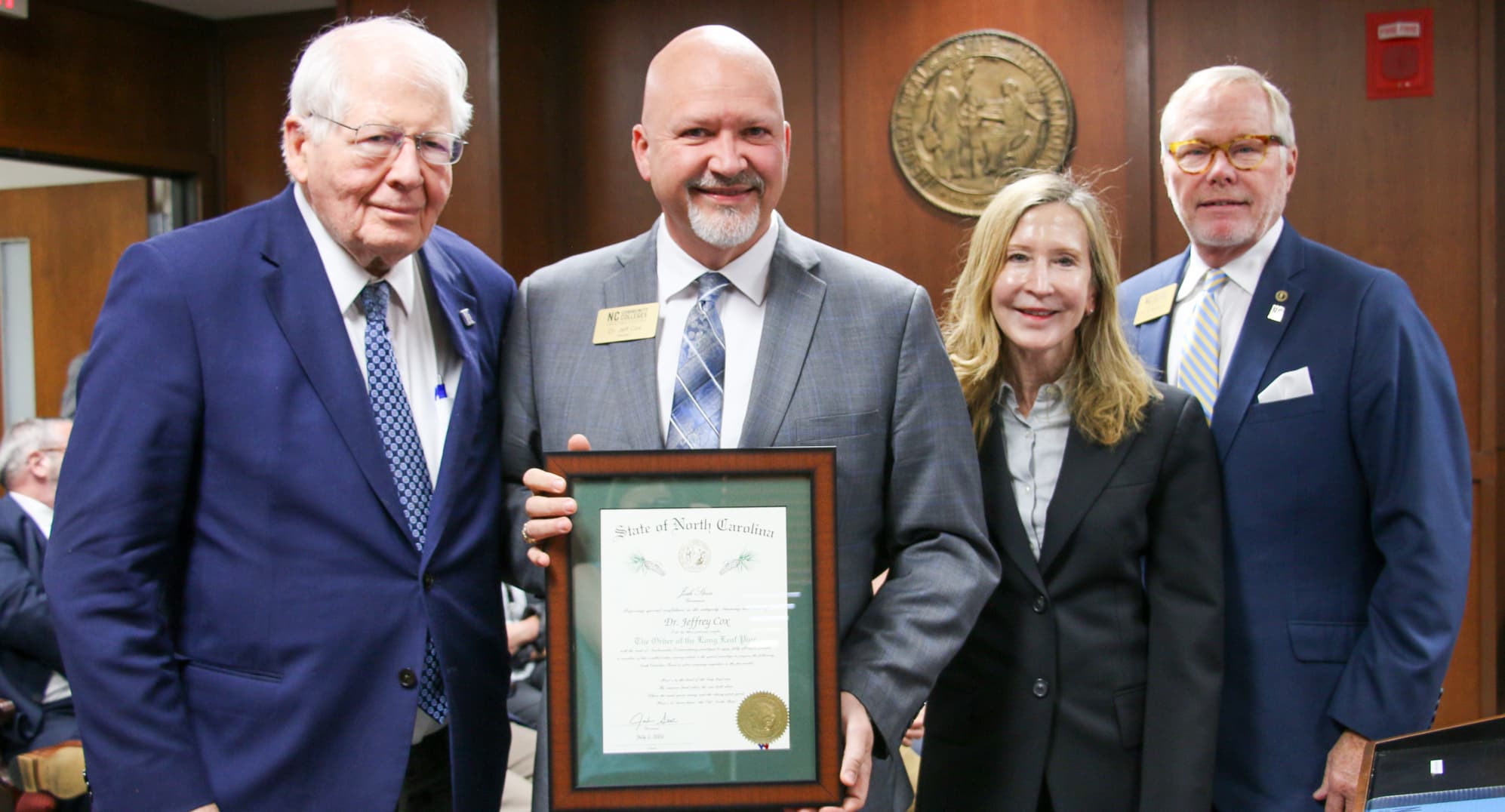
With weeks left in a career that started in a Guilford County classroom and ended at the head of North Carolina’s 58-college community college system, President Jeff Cox on Friday was awarded the Order of the Long Leaf Pine, the state’s highest civilian honor.
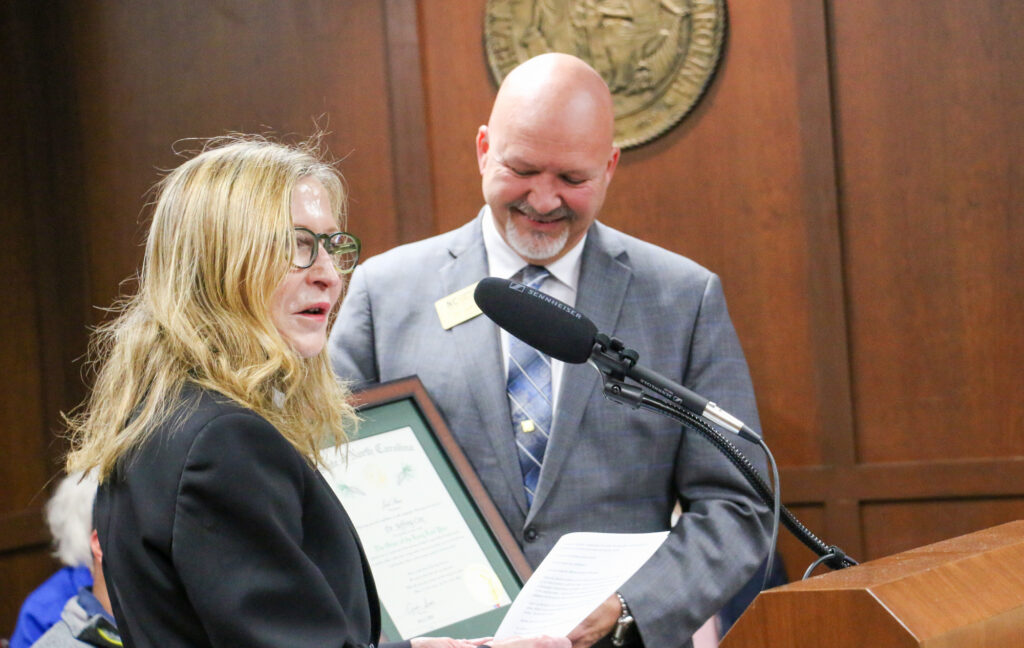
State Board of Community Colleges member Sarah West presented the award on behalf of Gov. Josh Stein at the Board’s May meeting in Raleigh, recognizing Cox’s three decades of service to public education in North Carolina. The Order, established in 1963, has been awarded to fewer than 20,000 North Carolinians in its 60-year history.
“It is not given lightly,” West said in presenting the award. “It is given to those whose work has left North Carolina measurably stronger than they found it.” Of Cox specifically, she said what unites the chapters of his career “is not position — it is purpose,” describing him as “steady, humble, collaborative, always pressing toward better, not for the sake of appearances, for the sake of students.”
Cox, who announced his retirement last August, will step down June 30. State Board Chair Tom Looney, recalling that announcement, said Cox “stepped up at a critical moment and brought much-needed stability and experience to the system, serving with heart.”
The State Board is in the final stages of a national search for Cox’s successor, with a transition expected later this year.
Cox’s career is, in many ways, a thoroughly North Carolina story. He grew up in Alleghany County, in the rural Blue Ridge mountains, a first-generation college student who never strayed far from the public schools that shaped him. He earned his bachelor’s and master’s degrees from Appalachian State University and his doctorate from UNC Charlotte, and built his career from the classroom up — starting as a high school English teacher in Greensboro and Sparta, earning the North Carolina Principal Fellows Scholarship, and advancing through school and college leadership before being named the 11th president of the NCCCS in 2023.
During his tenure, Cox guided the System through a sustained period of growth and modernization. He led the System through a record three-year enrollment recovery following the COVID-19 pandemic, oversaw the development and early rollout of PropelNC — a new funding and programming model aimed at connecting more North Carolinians to high-wage, high-demand careers — and helped shepherd the North Carolina Community Colleges Foundation through a year in which it raised more than $60 million in philanthropic support for the System’s 58 colleges.
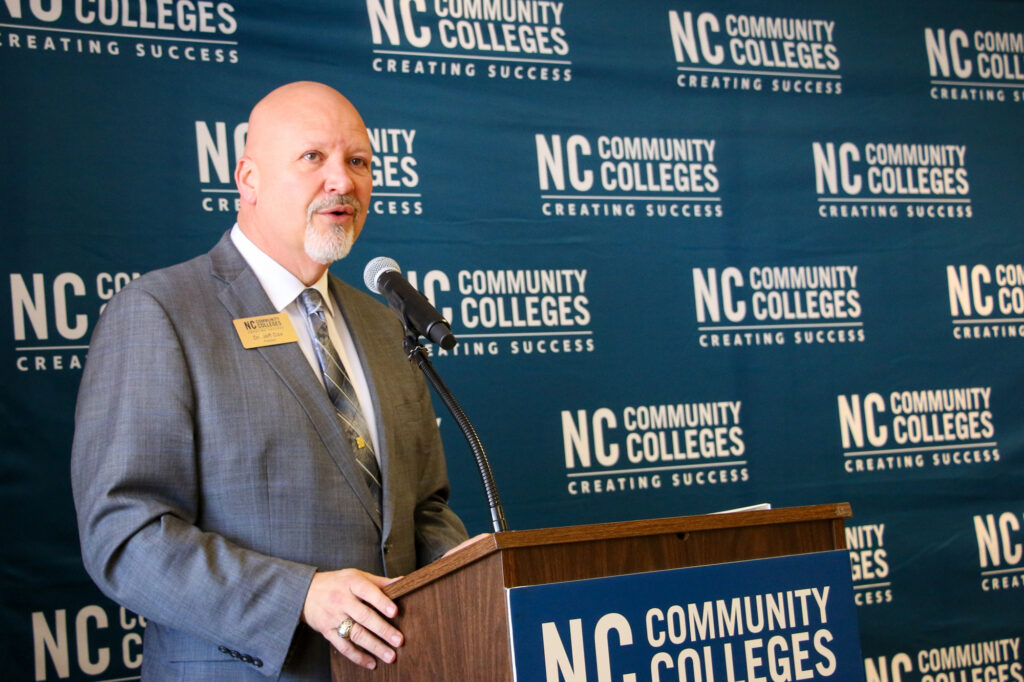
In his final address to the board Friday, Cox distilled what he called the real measure of the System’s success. “It’s not enough to get more students in the door,” he said. “It’s not even enough to get more out the door with certificates or diplomas. If those credentials don’t really have a transformative effect on the students, then we haven’t hit the mark.”
Cox closed his final board report the way he has ended every meeting for four years: with a student success story. This time, he shared two — and both were personal.
The first was Monica Torres, who Cox first met in 2005 as a third-grade student in Alleghany County while he was serving as superintendent. Growing up biracial, raised by a single mother, Torres showed early promise as a musician in the Junior Appalachian Musicians program, releasing her first CD before leaving elementary school. Cox was on stage for her eighth-grade promotion, her high school graduation from Alleghany High School in 2014, and — after she followed him to Wilkes Community College — her nursing pinning ceremony in May 2016.
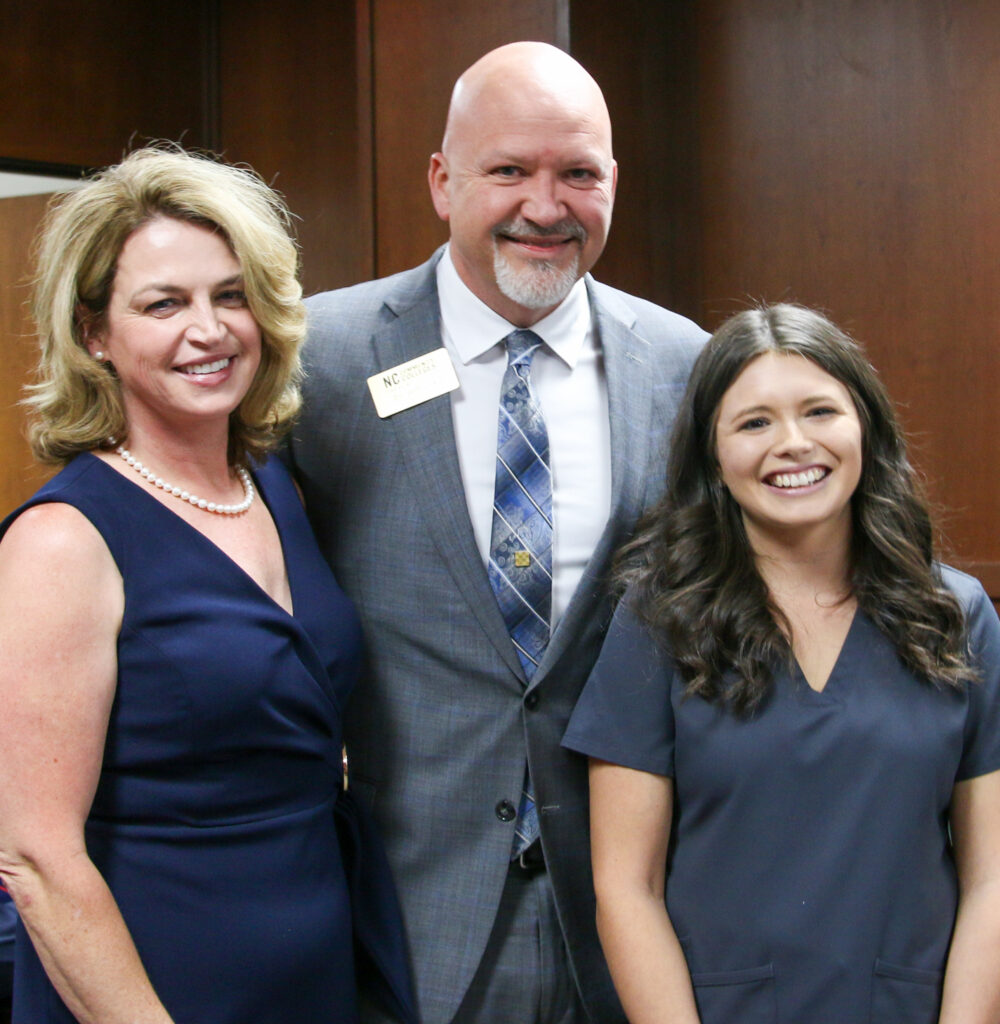
“She told me while she was in high school, she couldn’t imagine ever being anything more than a waitress at that Mexican restaurant,” Cox said. “Now she was gonna go on, be a nurse, and have a whole different life than she could ever have dreamed of.”
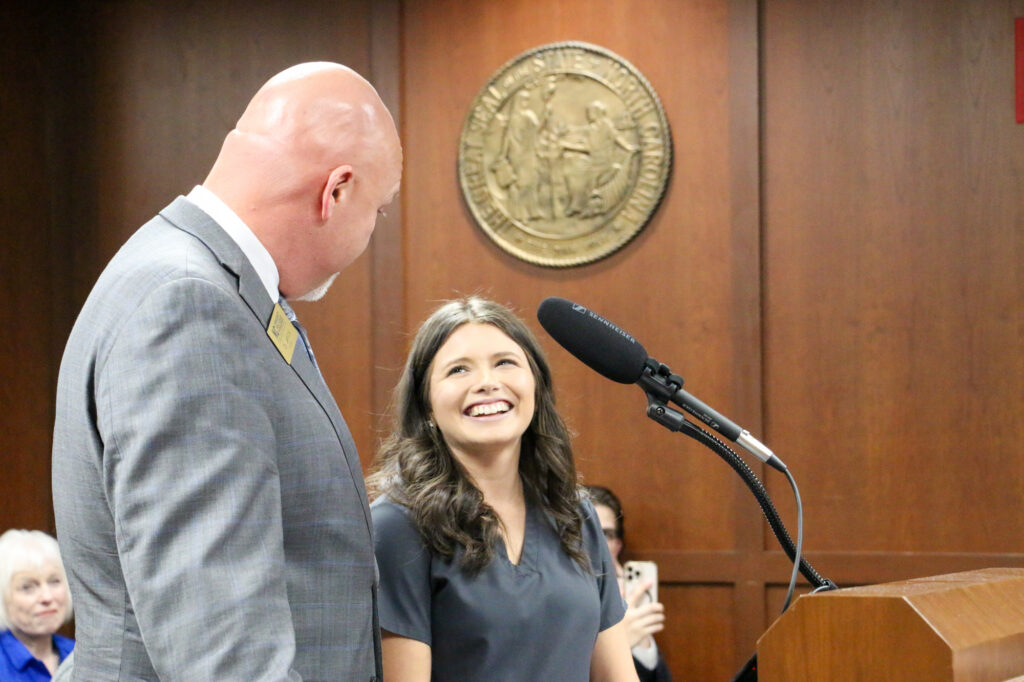
Torres, who surprised Cox by appearing in person at the meeting, now works as a nurse at a school clinic in the same community where she and Cox both grew up.
The second story was closer still — Cox called to the front of the room his wife, Reba, crediting her own journey through Wilkes Community College and Surry Community College as the foundation for a decades-long nursing career.
“She wouldn’t have had the amazing career she’s had, making these life and death decisions as a nurse, impacting thousands and thousands of lives,” Cox said, “if she hadn’t had that experience with the community college to help launch her path.”