State Board Approves Funding to Expand Student Access, Strengthen Workforce Training
Published: October 22, 2026
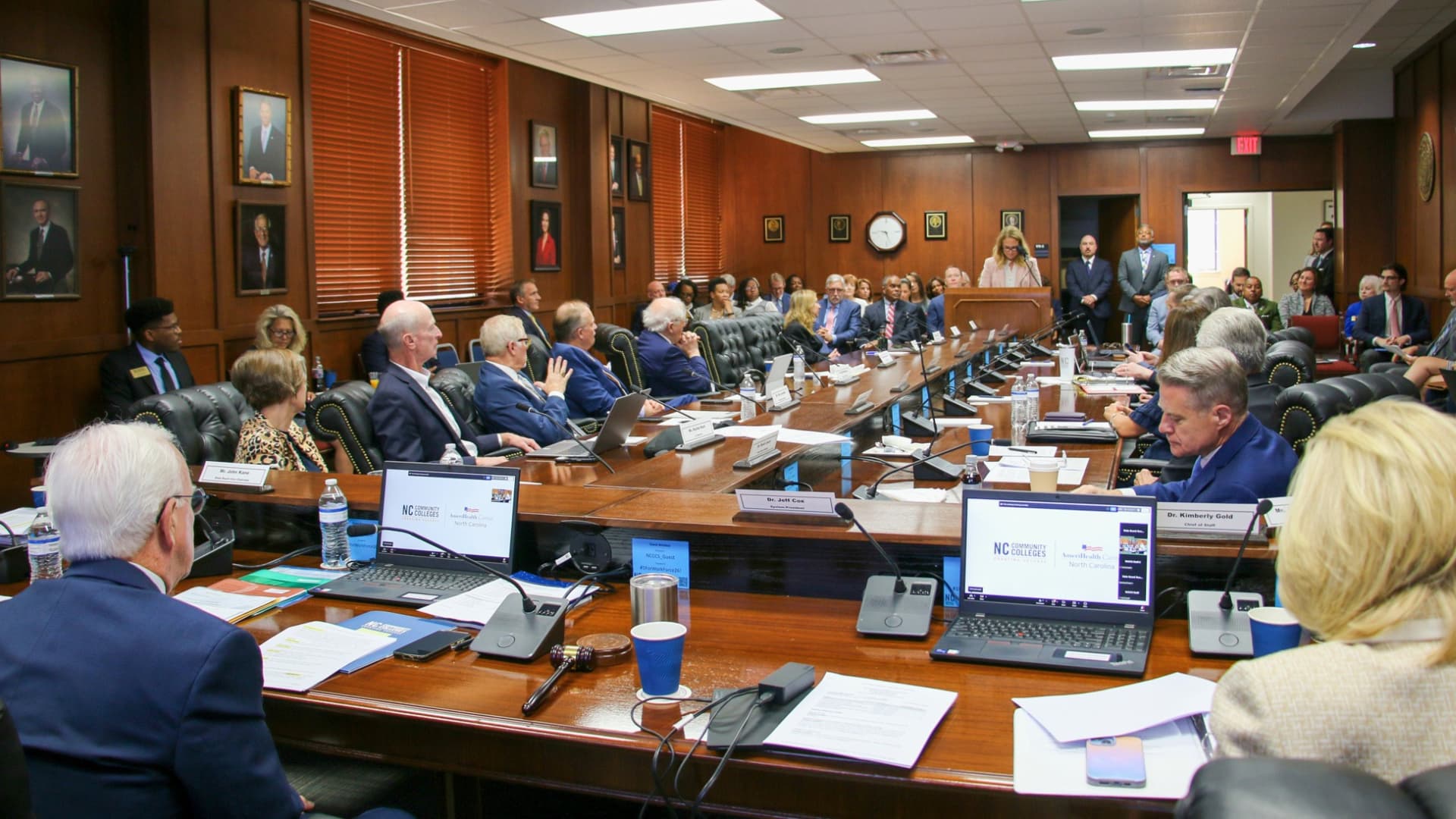
RALEIGH, N.C. — The North Carolina State Board of Community Colleges approved significant investments in student access and workforce training during its October 16 meeting and received an annual report on the growth of Registered Apprenticeship in North Carolina, advancing efforts to expand educational opportunities, address critical workforce needs, and strengthen North Carolina’s economy.
Among the actions, the Board approved $1.94 million to expand the Access to Achievement program to 10 additional colleges, nearly $3.9 million to support new high-cost workforce training programs, and additional funding to strengthen faculty recruitment and retention. The Board also reviewed continued growth and future expansion plans for ApprenticeshipNC.
Access to Achievement Expands to 25 Community Colleges
The Board approved $1.94 million to expand Access to Achievement, a state-funded workforce training initiative designed to help students with intellectual and developmental disabilities (IDD) gain career skills, earn credentials, and prepare for employment.
Initially launched as a pilot program at two colleges in 2022, Access to Achievement has since expanded to 15 colleges statewide. The latest investment, made possible through funding appropriated by the North Carolina General Assembly, will bring the program to 25 community colleges.
The 10 newly selected colleges will each receive $194,000 to establish the program:
- Bladen Community College
- Cape Fear Community College
- Central Carolina Community College
- Durham Technical Community College
- Fayetteville Technical Community College
- Gaston College
- Isothermal Community College
- Pitt Community College
- Southwestern Community College
- Wake Technical Community College
Nancye Gaj, Access to Achievement state director at the System, presented the expansion plans to the Board, highlighting the program’s emphasis on career preparation, credential attainment, and employment.
“Our funding is employment-focused and career-preparation-focused,” Gaj said. “We’re very much about career pathway development. We are very focused on employment and movement through the system.”
Through Access to Achievement, dedicated college coordinators work with students to develop individualized career plans, navigate educational pathways, and connect with available campus resources. Most participants take courses alongside other community college students, with additional support services designed to promote their success.
The initiative continues to demonstrate growing demand across the state. According to updated program data presented during the meeting, approximately 1,100 individuals participated during the 2025-26 academic year.
The expansion will also strengthen statewide outreach, professional development, and collaboration with public schools and employers. The System is planning additional regional resources to help students with IDD and their families navigate the transition from high school to community college and into the workforce.
Nearly $3.9 Million Approved for High-Cost Workforce Programs
In another major investment, the Board approved nearly $3.9 million in High-Cost Workforce Start-Up Grants to support 13 new programs across 15 community colleges, including two regional partnerships.
Established through nonrecurring state funding, the grant initiative helps colleges develop training programs in high-demand fields where specialized equipment, facilities, and instructional resources can create financial barriers to launching or expanding programs.
The funding is aligned with Propel NC workforce sectors, supporting the System’s broader efforts to prepare students for in-demand careers and respond to the evolving needs of North Carolina employers.
Interest in the competitive funding opportunity was substantial, with 38 of the state’s 58 community colleges submitting or participating in applications.
“We have more requests than we have money,” said Dr. Andrew Gardner, associate vice president of workforce strategies at the System, “so it was very well received by the colleges.”
Colleges selected to receive funding include Bladen, Blue Ridge, Brunswick, Craven, Fayetteville Technical, Guilford Technical, Johnston, Lenoir, McDowell, Piedmont, Randolph, Sampson, Sandhills, and Southeastern community colleges, and College of The Albemarle.
Grant funding may support eligible start-up expenses, including instructional equipment, faculty salaries, supplies, and accreditation costs. Participating colleges are required to provide matching funds based on enrollment-related criteria.
The Board also approved nearly $1 million in additional funding to support faculty recruitment and retention in high-demand workforce areas where colleges face challenges attracting and retaining qualified instructors.
Those areas include health care, engineering, advanced manufacturing, trades, transportation, information technology, public safety, and first responders. Together, the investments are designed to increase instructional capacity, expand access to high-demand career pathways, and help colleges meet regional workforce needs.
ApprenticeshipNC Reports Continued Growth, Outlines Expansion Strategy
The Board also received the annual report for ApprenticeshipNC, a part of the North Carolina Community College System.
John Loyack, the System’s vice president of economic development, presented the report, outlining continued growth in Registered Apprenticeships and plans to expand employer partnerships and work-based learning opportunities across North Carolina.
During the past year, ApprenticeshipNC registered 5,659 new apprentices, an increase of approximately 9% from the previous year. Pre-apprenticeship participation reached 2,054, representing growth of nearly 25%.
The report also highlighted the impact of new recurring state funding. The General Assembly allocated an additional $3.17 million annually to ApprenticeshipNC, bringing its total state appropriation to approximately $4.4 million.
State Board member Sarah West expressed appreciation for the investment and its potential to strengthen apprenticeship opportunities across North Carolina.
“We’re very pleased to acknowledge our deep gratitude to the General Assembly for its significant recurring investment in the ApprenticeshipNC program,” said West.
The investment provides a more sustainable foundation for statewide expansion following years of reliance on federal grant funding. With 10,286 active apprenticeship participants, ApprenticeshipNC has established a goal of reaching 13,962 participants during the next year.
To support that growth, ApprenticeshipNC will focus on strengthening its regional presence, expanding employer engagement, supporting Registered Apprenticeship sponsors, and improving program development and quality assurance.
Another priority will be the development of standardized occupational frameworks that provide employer-informed training pathways and related instruction. These frameworks are intended to help employers and community colleges develop and replicate Registered Apprenticeship Programs more efficiently while maintaining flexibility to address individual workforce needs.
Other Business
In addition to the major funding approvals and program reports, the Board addressed several operational, financial, and policy matters affecting the System and its 58 community colleges.
- Strategic planning: The Board continued discussions surrounding the System’s 2026-29 strategic plan, including an approach that places greater emphasis on operational priorities and actionable strategies. The plan is currently targeted for launch in February 2027.
- Tuition receipts: The Board approved the allocation of approximately $31.7 million in excess tuition receipts to community colleges following higher-than-budgeted collections during the 2025-26 fiscal year.
- State-required policies: The Board adopted three policies addressing technology procurement requirements, the distribution of mental health crisis support resources to students, and restrictions on certain state-funded educational benefits for individuals convicted of assaulting a state officer or employee.
- Fraud prevention: The Board received an update on the System’s efforts to identify and prevent fraudulent student applications. An updated registration process allows colleges to flag suspected and confirmed fraudulent applications, and the System’s data warehouse helps identify potential fraud across institutions.
The State Board of Community Colleges will hold its next meeting Nov. 19-20, 2026.