Nearly 4 in 10 NC High School Graduates Now Earning College Credit — And the Numbers Keep Climbing
Published: March 2, 2026
RALEIGH, N.C. — North Carolina is seeing a record number of high schoolers graduate with college credits in hand. New data from the State Board of Community Colleges reveals that 38% of the 2024–2025 graduating class enrolled in at least one dual enrollment course—an increase of 4,617 students over the previous year. This growth was felt across the board, with participation rising 10% among public school students and 11% in private and home schools.
The volume of coursework also surged, with students enrolling in 257,343 credit-level college courses, a 16% jump from the prior year. Ultimately, 36% of all graduates (42,128 students) earned high school credit through these opportunities. Within the College and Career Promise (CCP) program, 95% of participants successfully earned credit toward graduation. System leaders highlighted CCP as a cornerstone strategy for expanding college access and strengthening North Carolina’s workforce pipeline.
Expanding career pathways through collaboration
The Board discussed continued efforts to strengthen Career and Technical Education (CTE) pathways, including expanded pre-apprenticeship opportunities and industry-aligned coursework developed in partnership with K-12 systems and employers.
“With the support of the State Board, the work we are doing to expand CTE pathways will create more pre-apprenticeship opportunities and college prep coursework, similar to South Piedmont, with other community colleges. It takes a village to make this work, but when school districts and colleges work collaboratively with industry partners, students like Logun are granted opportunities to flourish,” said Aaron Mabe, State Director of Dual Enrollment.
System leaders highlighted Logun’s journey as an example of how dual enrollment, pre-apprenticeship programs, and industry partnerships can lead directly to employment. After completing his junior year in 2024, Logun earned a certificate in industrial systems through South Piedmont Community College’s dual enrollment program — including coursework in welding, machining, and hydraulic systems — and participated in the Anson High School Pre-Apprenticeship program through a partnership with Southern Fabricators, Inc. Following graduation in May 2025, he accepted full-time employment with the company.
Strengthening system resources through philanthropy
The North Carolina Community Colleges Foundation provided an update on its multiyear campaign to raise $75 million from national and multinational funders in support of student success, workforce alignment, and economic mobility.
Executive Director Katie Loovis reported that the campaign has raised $53.6 million — 71% of the overall goal — as of January. Two-thirds of those funds stem from a $35.6 million gift from Arnold Ventures to support Boost, the state’s college-to-career initiative focused on increasing completion rates and connecting students to high-wage, in-demand careers. Upcoming investments in the pipeline include PropelNC-aligned scholarships with a focus on health care pathways.
The Foundation is also launching a national reputation effort to elevate the system’s work among funders outside North Carolina, and reported that last year was its strongest fundraising and distribution year to date.
“We were able to push out nearly $5 million dollars to our colleges, and when you stack them up, all the colleges and how much they got, it really feels great. And we want to do more and make sure we’re helping all 58 of them,” Loovis said.
Legislative agenda centered on PropelNC
System leaders outlined the legislative agenda for the General Assembly’s upcoming short session, centered on advancing the PropelNC funding model and strengthening college capacity to meet enrollment and workforce needs.
Alex Fagg, Vice President of Government and External Relations, highlighted a request for $68.5 million in recurring funding to modernize the workforce sector funding formula, along with $24.4 million in recurring base funding and $6 million in nonrecurring funds for an enrollment growth reserve. The agenda also includes statutory changes to redistribute excess tuition receipts, funding for multicampus centers at Alamance, Forsyth Tech, and Wake Tech community colleges, and salary increases aligned with state employee rates.
The System is also requesting $3.1 million in recurring funding for ApprenticeshipNC to reduce reliance on federal funds and expand program flexibility.
“If you move from federal to state opportunities, you add more flexibility, growth, improvement. Right now, our mindset is to prepare for anything and everything,” Fagg said.
Leaders emphasized the need for capital and equipment funding to address approximately $3 billion in statewide infrastructure needs, and noted that the System is preparing for multiple legislative scenarios amid the ongoing budget impasse.
Leadership transition updates
The Board received updates on the presidential search following President Dr. Jeff Cox’s planned retirement on June 30. Board Chair Tom Looney shared an updated timeline with the goal of appointing a new president in July. A newly formed executive committee also convened for the first time to support system alignment and decision-making during the leadership transition.
 Additional Board actions and announcements
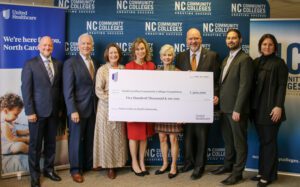
UnitedHealthcare Community Plan of North Carolina announced a $500,000 investment to launch the Future Leaders in Health Scholarship Program, supporting 400 students over three years across 35 community colleges in high-need health care workforce regions.
“Across North Carolina, we’ve continued to see meaningful economic growth and opportunity. But sustaining that growth and ensuring the health and well-being of our local communities requires access to a strong, reliable health care workforce,” said Anita Bachmann, CEO, UnitedHealthcare Community Plan of North Carolina
The Board approved $24,573,657 in enrollment growth reserve funds for 47 colleges that exceeded fall 2025 budgeted enrollment levels by more than 5%.
The State Board of Community Colleges will meet again March 19–20.