DRAFT: Transfer Toolkit - North Carolina's Four Year Institutions
Jump Right To:
Transfer Questions
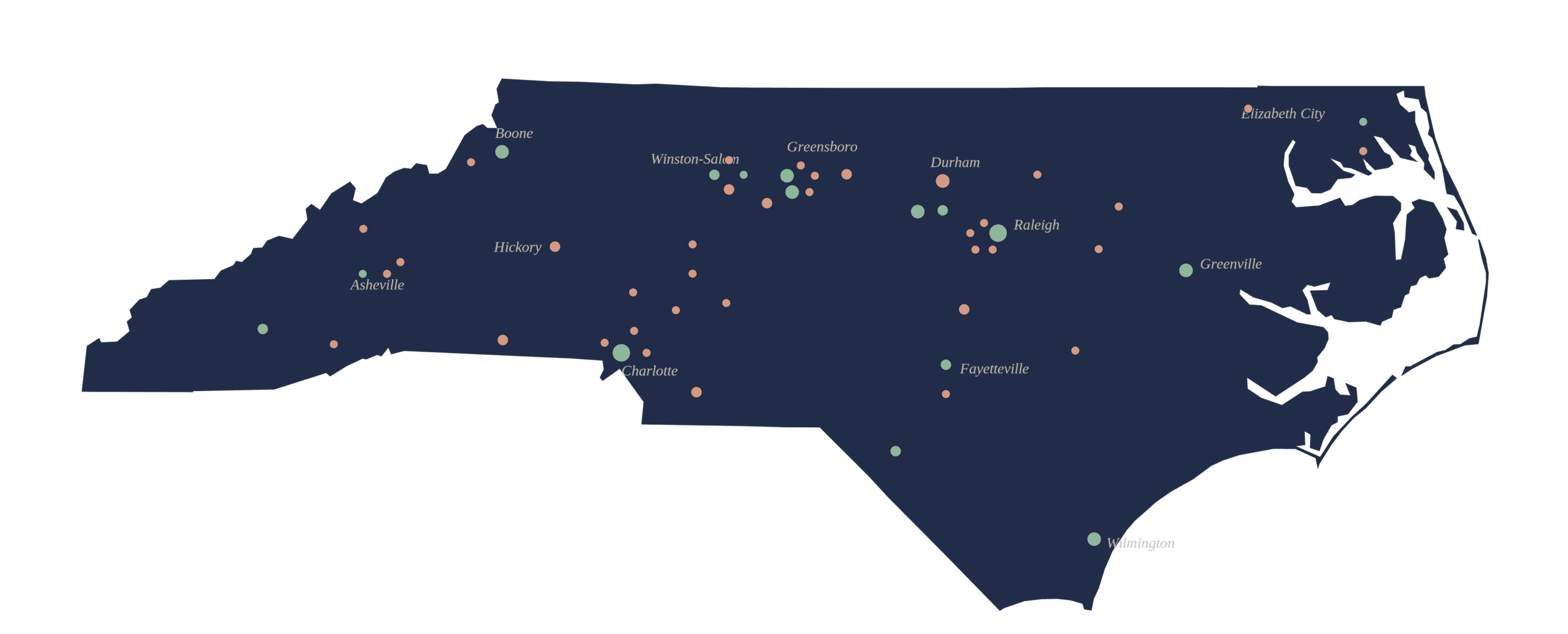
What institutions are in North Carolina?
How do I decide where to transfer?
Start by exploring institutions that offer the desired major, preferred campus environment, geographic location, cost, and support services. Visiting institutions and meeting with admissions staff can help narrow choices.
Transfer Questions
When should I apply to a four-year institution?
Application deadlines vary by institution and term, but as applications open is recommended. Most universities recommend applying at least one semester before you plan to enroll, but the earlier the better, as the timeline may affect scholarship opportunities or major-specific admission.
How do I learn more about the Comprehensive Articulation Agreements (CAA)?
The CAA and the ICAA ( which applies to the independent institutions in North Carolina,) are statewide agreements that outline certain rights and responsibilities for both the community college system and the four-year institutions. Included in the document is how general education courses must transfer, a list of agreed upon transfer courses, your right to appeal a transfer credit decision, and much more. You can learn about both the CAA and the ICAA, which applies to the independent institutions in North Carolina, on the system's transfer resource page.
Does the Associate of Arts (A.A.)/Associate of Science(A.S.) qualify me for guaranteed admission under the Comprehensive Articulation Agree (CAA)?
Yes, with an A.A. or A.S. degree meeting the minimum GPA (2.0 minimum, though competitive institutions/programs expect higher), the CAA guarantees admission to a UNC System institution as outlined in the Transfer Assured Admissions Policy (TAAP). The ICAA does not guarantee admission.
What GPA is needed for transfer?
Requirements vary by institution and program. Competitive majors such as nursing, engineering, business, and education often require higher GPAs than the institution's minimum transfer requirement.
How many total transfer credits will the institution accept, and is there a residency requirement?
Ask this at every school, institutions usually cap credits (commonly around 60-70 semester hours) and minimum "last X hours completed in residence" rules vary by institution and aren't standardized across NCICU schools the way they roughly are within the UNC System.
Will coursework need to be repeated after transferring?
Possibly. Individual four year institutions will determine equivalencies for college coursework completed elsewhere. While a course at the community college may have a similar name or similar content to a course at a university, it is possible that direct equivalency may not be awarded due to critical content differences, major-specific recommendations, accreditation requirements, etc. You can review institutional equivalency tables or the NCICU Transfer Portal to better understand if the coursework they're taking will transfer and/or has a direct equivalency.
Will the school use the Universal General Education Transfer Component (UGETC) to satisfy General Education (GE) requirements?
UGETC-designated courses are guaranteed to transfer and satisfy GE requirements at any UNC System school or any NCICU institution that has signed onto the ICAA. Courses outside the UGETC list may transfer as credit but not necessarily fulfill a specific requirement.
If it's an NCICU school, has that specific institution actually signed the Independent Comprehensive Articulation Agreement (ICAA)?
Not automatically, the ICAA only binds signatory institutions. NCICU has roughly 36 member colleges and universities, but not all of them are ICAA signatories, and signatory status can change. Always confirm the specific institution's status directly rather than assuming NCICU membership equals ICAA participation.
Is there a bilateral or discipline-specific agreement between my community college and four-year schools?
Possibly. Bilateral agreements are unique contracts between two colleges, often because they're geographically close or have closely related programs, these can offer stronger guarantees than the general statewide agreements. Work with your community college advisor to learn more.
Do my placement test scores (math, writing, foreign language) carry over, or will I need to retest at the new institution?
Placement often isn't just about transferred credit. Some four-year schools require their own placement exam for sequencing regardless of prior coursework. Consult with an admissions counselor or advisor at the four-year to learn more.
Will Credit for Prior Learning (CPL), transfer as equated by the community college, or will they be re-evaluated?
In most cases, Credit for Prior Learning will be re-evaluated by a four-year institution during the transfer admissions process. Most universities have established CPL policies they follow when determining transfer credit awarded for CPL and will require students to submit documentation (official test scores, JST, certifications, resume, etc.) for institutional review to determine if any transfer credit can be awarded.
Is financial aid available for transfer students?
Yes. Transfer students may be eligible for federal aid, state aid, institutional aid, scholarships, and transfer-specific scholarships. Explore the financial aid and scholarship section on this site and reach out to your intended institution's admissions and financial aid office for opportunities.
Do universities offer scholarships specifically for transfer students?
Many institutions offer transfer-specific scholarships. It is important to note that scholarships may require a separate application and may have different deadlines than the university's transfer admissions process. Explore the financial aid and scholarship section on this site and reach out to your intended institution's admissions and financial aid office for opportunities.
Am I guaranteed housing?
Maybe, you will need to talk with a representative from the institution to learn more.
How do I decide where to transfer?
Start by exploring institutions that offer the desired major, preferred campus environment, geographic location, cost, and support services. Visiting institutions and meeting with admissions staff can help narrow choices.
When should official transcripts be sent, and from where?
During the transfer admissions process, most four year institutions will require transfer students to submit an official transcript from their current institution as well as all previously attended institutions, so it is important to plan accordingly. If you are applying to transfer while still actively enrolled in community college coursework, you should plan to send an official transcript at the time you apply and again once your current semester ends and grades are finalized/degree has been conferred. Generally, official transcripts can be sent electronically or by mail to intended institutions by contacting the Records/Registrar at the community college.
When does I get access to the new institution's systems (email, student portal, library, learning management system (LMS)?
This varies by institution, and the level of access may change as students reach certain milestones or steps. For example, admission information will likely be available at the time of application, but an email account may not be set up until you accept admission. Access to Canvas or another LMS likely won't happen until registration.
Are health/immunization records, background checks, or other compliance documents required before registration?
This varies by institution; consult with an admissions representative or advisor to learn more. And always watch your email or mail for important information like this!
Is there continuity for accommodations between the two institutions, or does I need to reapply for those services at the new school?
Accommodations don't automatically transfer. You will likely need to register with your new school's disability services office and may need to submit relevant documentation.